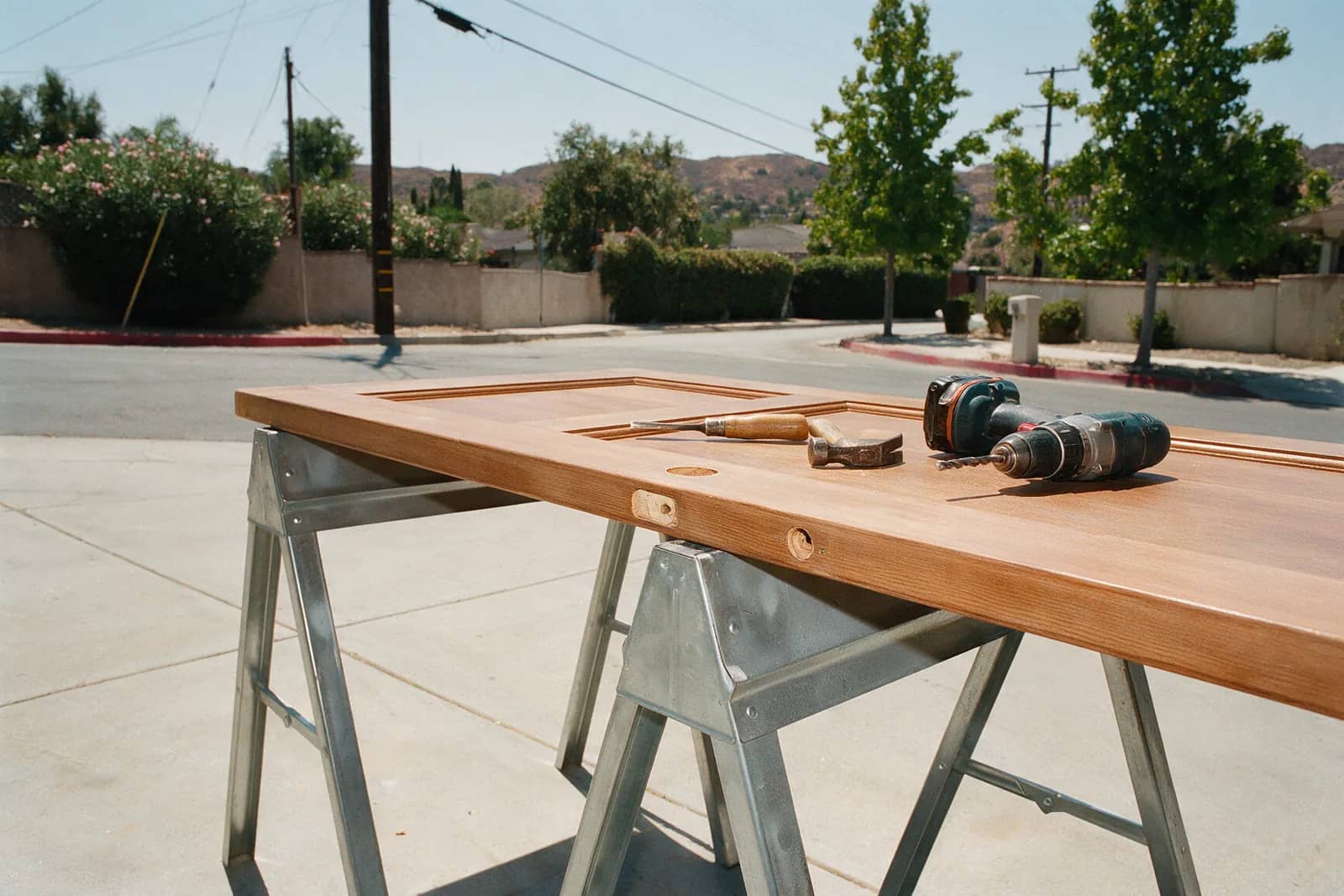
How the second hole got there
A tract house built in 1961 came with a keyed knob and nothing else. Sometime in the seventies, after a run of break-ins or a conversation over a fence, deadbolts went on. Some were fitted by a carpenter with a proper jig. Plenty were fitted by the owner with a hole saw borrowed from a neighbor, marked by eye, drilled from one side, and finished when it went through the paint on the far face and blew out a ring of it.
Fifty years later that is the door you are standing at. The knob is original and sits exactly where every other knob on the street sits. The deadbolt above it is a hand-drilled hole, and everything that is now awkward about that door traces back to how it was marked. It is worth saying plainly that this is not a defect in your house. It is the commonest condition of a front door in this city, and most of it can be put right without replacing the slab.
Two backsets on one door
The knob was bored at whatever the builder's jig was set to, either 2-3/8 or 2-3/4 inches from the edge. The deadbolt was drilled at whatever the hole saw guide on the box suggested, or at whatever looked right. When those two differ, the deadbolt sits visibly inboard or outboard of the knob below it. Cosmetically it is a line that does not line up. Functionally it matters more than it looks, because the bolt is now throwing into a strike that was cut to suit it, and the two strikes on that jamb are at different depths.
The second problem is the edge bore. A deadbolt hole drilled from one face and finished from the other rarely meets in the middle exactly, and the edge bore for the bolt is often not square to the face. The result is a bolt that binds, that throws two-thirds of the way and stops, or that only works when the door is pulled toward the hinge side. People live with that for years and describe it as the door being stiff. A bolt that does not throw its full length into the jamb is doing a fraction of the work it was bought to do, and that is worth knowing before anything is spent on a better lock.
The strike is usually the real fault
More of these doors fail at the jamb than at the lock. Two things go wrong. The mortise for the strike was cut shallow and short, so the bolt bottoms out on wood before it is fully home. And the strike was fastened with the three-quarter inch screws in the box, which reach into the jamb casing and no further. The jamb on a tract house is a thin board with an air gap behind it and the framing an inch or so back. Short screws hold a strike plate to a board that is holding nothing.
The fix is cheap and it is the single most valuable thing done on these doors. Deepen the mortise so the bolt travels its whole length, reposition the strike where the bolt actually arrives rather than where somebody guessed, and drive long screws through the jamb and into the framing behind it. It costs a fraction of new hardware and does more. Any visit here checks that before anybody discusses replacing a lock, because selling a new deadbolt into a jamb held by three-quarter inch screws is selling the wrong thing.
The filled hole, the wrong plate and the paint ring
Then there is the archaeology. Doors on these streets often carry a hole from a lock that was removed, filled with a dowel, a plug of putty or in one memorable case a wine cork and a coat of gloss. There are old strike outlines on the jamb, a rectangle of unfaded paint where a bigger escutcheon used to be, and a screw hole pattern from a chain that came off in the nineties. New hardware has to land in that landscape.
Three ways through it, in order of preference. Choose hardware whose rose or plate is at least as large as what came off, so nothing new is exposed. Fit a wraparound plate, which covers a chewed or split area around the bore and stiffens the stile at the same time, and is genuinely useful on a door that has been forced once already. Or fill and finish properly, which means a fitted wood plug rather than filler on an exterior door, since filler moves with the seasons and comes back as a crack. What does not work is a small modern rose on a door with a large old footprint. It puts the history on display instead of solving it.
When the door itself is the answer
Sometimes the honest recommendation is that no lock will fix this door. A hollow-core slab hung as a front door, which does turn up on side and rear entries here, has nothing but a strip of wood around the edge to hold a bolt. A slab with three or four holes through it from successive locks is a slab with very little left between the bores. A door that has been forced and repaired twice, with split wood around the edge bore, is not made sound by better hardware. And a door that has dropped on its hinges so far that the bolt only meets the strike when the door is lifted is a hinge and frame job before it is anything else.
That last one is worth trying yourself. Open the door, lift it at the handle edge, and see how much it moves. If there is play, the top hinge screws have usually pulled out of the jamb, and driving long screws into the framing behind the top hinge often brings a whole door back into alignment for the cost of six screws. Doing that first has saved plenty of people on these streets a lock they did not need.
What it costs to sort out a door like this
Rekeying the existing knob and deadbolt onto one key, once they turn properly, is $25 to $40 a cylinder, counted on the call so one figure covers the door or the house with the visit already inside it. New hardware, correctly bored and with the strike and the frame put right, is $112 to $285 per door. A door that has been forced and needs the frame, the strike and the cylinder together is $159 to $399. A lockout on one of these doors is $115 to $195 and it gets picked rather than forced, which matters more than usual on a slab that has already been drilled through three times. Arrival is sixteen to twenty-six minutes across Concord.
Todos Santos Lock Co. works to The Known Door. One figure said on the call, holding the visit, the labor and the parts. The same figure on the receipt whatever is found once the plates come off, and on doors like these something is usually found. The lock is opened without damage first, and a drill comes out only after you have agreed to it and never to reach a higher figure. Card or tap at the door, an itemized receipt by email, and a written line for a landlord, a manager or an insurer when it is needed. Calls are answered 24/7, with $40 inside the figure from 8pm to midnight and $75 from midnight to 7am, which raises a late call within its range and not beyond it.
Quick answers
My deadbolt is not in line with the knob below it. Does that matter?+
Cosmetically it is a line out of true. Functionally what matters is whether the bolt throws its full length into the jamb. A hand-drilled hole from the seventies often leaves a bolt that binds or stops two-thirds of the way, and that is corrected at the edge bore and the strike rather than by buying a better lock.
The bolt only turns when I pull the door toward me. Why?+
Usually the door has dropped on its hinges, or the strike mortise is shallow and off position. Long screws through the top hinge into the framing behind the jamb often lift a whole door back into line, and deepening and repositioning the strike does the rest. Both cost far less than hardware.
There is an old filled hole in my door. Can new hardware cover it?+
Often, if the new rose or plate is at least as large as the footprint that came off, or if a wraparound plate is used, which also stiffens a stile that has been forced. On an exterior door a fitted wood plug outlasts filler, which moves with the seasons and cracks back open.
Need it handled rather than read about?
(925) 421-2295More guides