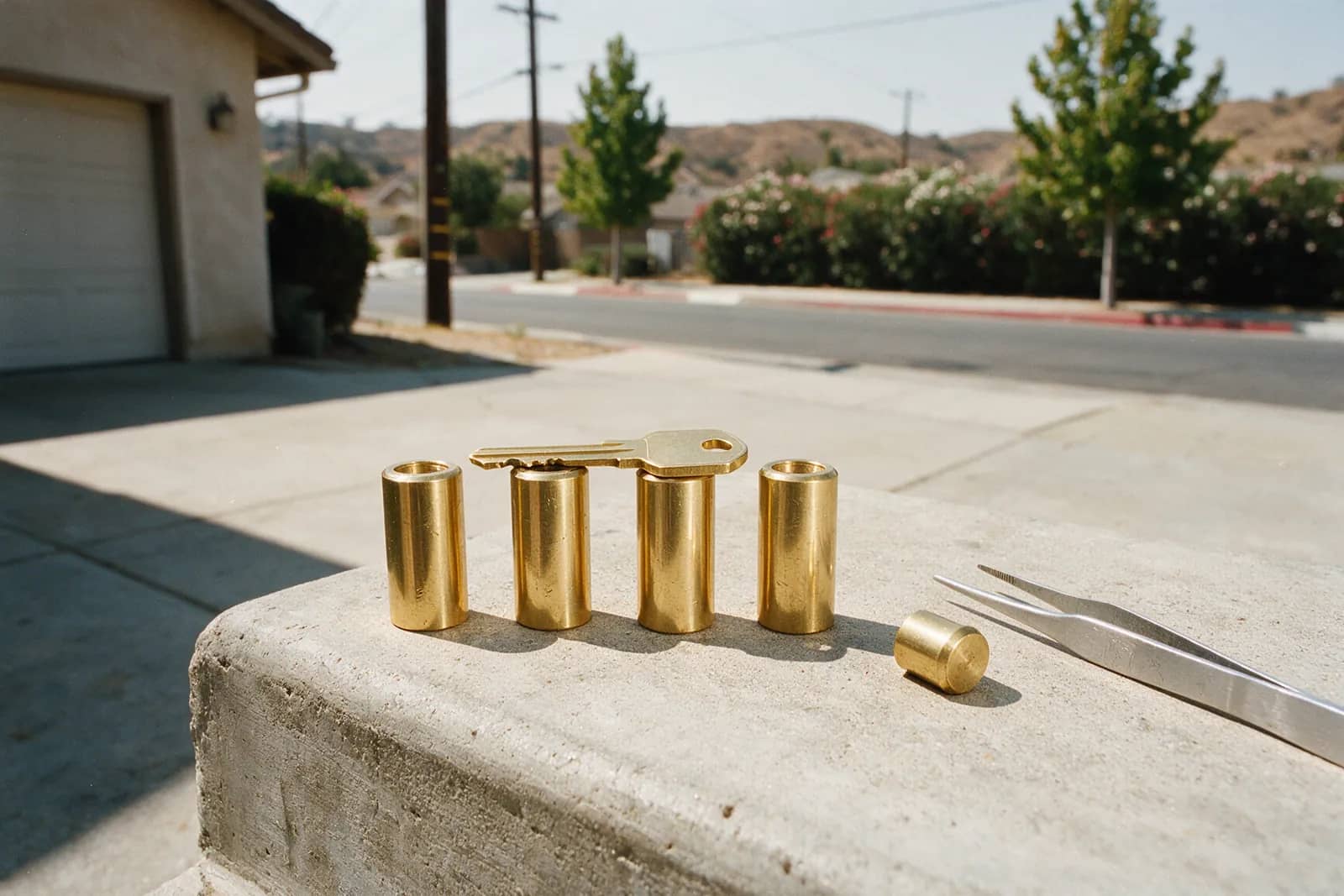
How a house ends up with five keys
Nobody planned it. The front door still has the entry set the builder hung. The back door was replaced in the eighties and came with its own key. Somebody added a deadbolt after a break-in two streets over and that came with two more. The garage side door got a lock from a hardware counter one Saturday. The gate to the back yard has a padlock bought for a specific afternoon and never thought about again. Five keys on a ring, and at least one of them nobody can name.
Bringing them onto one key is called keying alike, and it is the same work as any rekey: the cylinders come apart, the pin stacks are changed to match a single new key, and everything goes back on the same doors with the same hardware. Nothing on the outside of the house changes. The old keys stop working, which is often the actual reason for the call, because a house has changed hands, a tenant has left, a contractor had a copy, or a marriage has ended.
The keyway is what decides it
A cylinder can only be pinned to a key that physically enters it. The shape of the slot down the middle of the keyway is the constraint, and there are two common families on Concord houses: the flat five-pin type the tract builders fitted by the thousand, and the six-pin type with the deeper key profile that turns up on later replacements and on most sixties commercial-grade sets. A key cut for one will not go into the other, and no amount of pinning changes that.
So the first thing on a keyed-alike visit is a count of what family each door belongs to. Where a house is all one family, everything comes onto one key and nothing gets replaced. Where there is a mix, there are two honest choices. Convert the odd ones out by fitting a matching cylinder, which on most deadbolts and entry sets is a part swap rather than a new lock, or keep two keys and be deliberate about which is which. A house with the front and back on one key and a garage on another is not a failure. Four unmarked keys with no logic behind them is.
The garage side door, and the door into the kitchen
The side door on a detached garage is the door people forget, and it is the one that most often has the weakest lock in the property on it. It is also the door that leads to a workbench, a bicycle and a ladder, and on the tract streets it sits behind a gate where nobody can see it from the road. It usually takes an ordinary bored lock and comes onto the house key without argument.
The door from an attached garage into the kitchen is a different case worth thinking about once. If it comes onto the house key, then anybody who gets into the garage is one familiar key away from the kitchen, and that garage is often opened by a remote clipped to a visor in a car parked outside. If it stays on its own key, then getting into the house through the garage needs a second key that lives indoors. Neither is wrong. What matters is that it was a decision rather than an accident. Also worth naming: a roll-up garage door with a T-handle and its own small wafer cylinder is not in either key family and cannot join the set, though it can be given a key of its own that matches the other T-handles on a property.
The back gate and what actually holds it
Gates come up on nearly every one of these calls, particularly on the Clayton Valley and Crystyl Ranch streets where the lot climbs and the side gate is the only way to the back. A padlock with a rekeyable cylinder can be brought onto the house key, and so can a keyed gate latch built to take a standard cylinder. A sealed padlock from a bin cannot: there is nothing in it to repin, and the answer there is a matched replacement rather than a rekey.
Two practical notes on gates. First, a gate lives outdoors, so a brass body with drain holes and a stainless shackle lasts, and a plated steel one bought for one afternoon does not. Second, a gate is not a front door and should not be treated as one. Its job is to slow somebody down and to stop a gate blowing open, and the strongest padlock in the world on a hasp screwed into soft redwood with three short screws is holding nothing. The screws matter more than the lock. That gets pointed out on site rather than sold around.
What cannot come onto your key at all
Some locks on a Concord property are simply not yours to change, and it saves a wasted visit to say which. If your mail arrives in a shared cluster box at the end of the street, that lock belongs to the postal service and is replaced by them, not by a locksmith and not by the homeowner. A community gate on a shared driveway or a shared pool is the association's hardware, and the association authorizes work on it. If you rent, the front door of the unit is the owner's hardware, and the manager or the landlord asks for the rekey, not the tenant on their own account.
Two more that are technical rather than legal. A smart lock without a physical keyway has no cylinder to pin, so it cannot join a key set at all, which is one more reason to keep a keyed deadbolt somewhere on the house. And a high-security cylinder on a restricted keyway can be keyed alike within its own system, but nothing outside that system can join it, because the whole point of it is that blanks are controlled. If you already have one of those, say so on the call.
How a whole house is counted, and the figures
Rekeying is $25 to $40 a cylinder. A house is not billed as a visit with cylinders stacked on afterwards: the doors get counted on the call, one figure is said for the property, and the $89 visit is already sitting inside it. Count carefully before calling, because the count is the figure. Front door knob and deadbolt is two cylinders, not one. A back door with a knob and a bolt is two more. Garage side door, gate padlock, a shed, a side door onto the driveway. Five and six are ordinary numbers on these streets.
Where a cylinder has to be swapped rather than repinned, that door moves into lock replacement and installation at $112 to $285, and it is named as its own line before anything comes off the door. Arrival is sixteen to thirty-one minutes across Concord, with the Ygnacio Valley streets around twenty-three and Clayton Valley twenty-six. The Known Door is how the money works: one figure said on the call covering the visit, the labor and the parts; the same figure on the receipt whatever turns up inside the cylinders; the lock opened without damage first and a drill only with your agreement and never at a higher figure; card or tap at the door, an itemized receipt by email, and a written line for a landlord, a manager or an insurer. Calls are answered 24/7, and the $40 evening and $75 overnight amounts sit inside the figure, moving a late call up within its range rather than above it.
Quick answers
Can every lock on my house go onto one key?+
Every lock that shares a keyway family can, and on a tract house that is usually most of them. A mismatched door can be brought in by swapping its cylinder, which is a part rather than a whole new lock. A sealed padlock, a roll-up T-handle and a smart lock with no keyway cannot join the set.
How is a whole-house rekey counted?+
By cylinder, at $25 to $40 each, with the doors counted on the call so one figure comes back for the property and the $89 visit is already inside it. A front door with a knob and a deadbolt is two cylinders. Five or six across a house on these streets is normal.
Should the door from the garage into the kitchen be on the house key?+
It can be either way, and the point is to choose rather than inherit it. On the house key, anyone who gets the garage open is one familiar key from the kitchen, and the garage remote often lives in a car on the driveway. On its own key, that route needs a second key kept indoors.
Need it handled rather than read about?
(925) 421-2295More guides