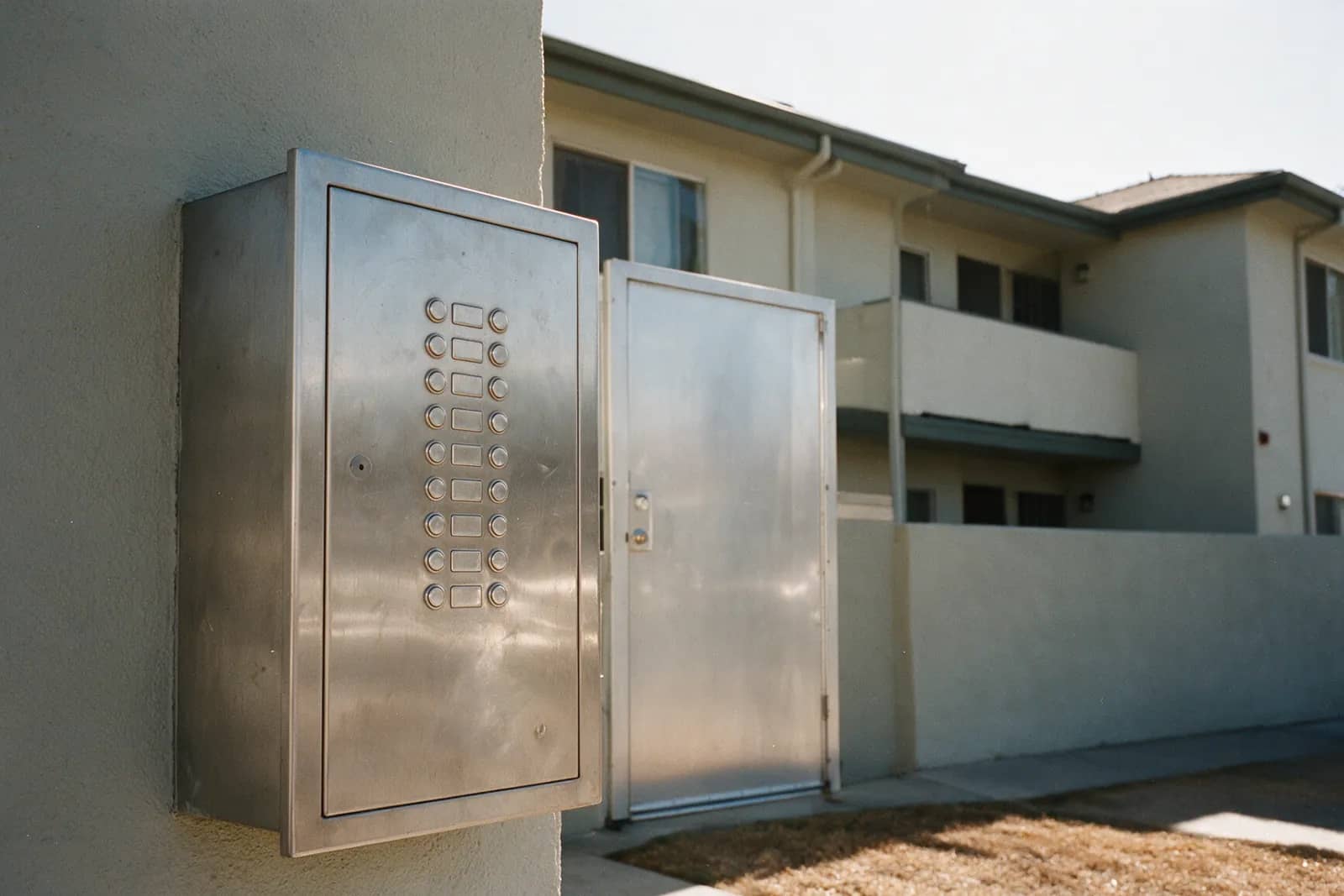
Two doors between you and your couch
On the Monument corridor most people pass through two locked doors to get home. There is the street door or the gate with the panel of buttons beside it, and then there is the door of the unit itself. They look like one system because you meet them thirty seconds apart, but they belong to different people. The unit door is the owner's hardware, managed through whoever holds your lease. The street door, the panel, the gate to the parking, the laundry room and the mail are building hardware, and the building decides what happens to them.
That split is the single most useful thing to know before making a call, because it determines who has to ask. A locksmith works on a door for the person entitled to that door. On a rented unit that is the owner or the manager acting for them. That is not a formality invented to slow things down; it is the reason a stranger cannot have your door opened by describing it convincingly.
What the panel by the street door actually is
The board of buttons and numbers is a telephone entry panel. It holds a directory, each entry tied to a code and a phone number, and when a visitor keys the code it calls the number on file. Answering the call and pressing a digit sends a signal to an electric strike or a magnetic lock at the door, which releases for a few seconds. There is no key involved in that part of it and no cylinder to rekey.
So when a tenant says the buzzer does not work, it is nearly always one of three things and none is a lock. The phone number in the panel is the old number, because the unit changed hands and the directory did not. The code in the directory is not the unit number, which is deliberate in a lot of buildings and confusing in all of them. Or the door release itself is failing, which is electrical and lives at the strike. Every one of those is programmed or repaired with the manager's authorization, because the panel serves the whole building. What a tenant can do alone is report it accurately, which is most of the work: say whether the panel rings you, whether you can hear the caller, and whether the door releases when you press the digit.
Your own door, and what the lease says about it
The unit door is where a tenant has standing, and it is still not unlimited. If you are locked out of your own apartment, that door gets opened for you on proof that you live there, and no landlord permission is needed to let a resident back into their home. If you want the cylinder rekeyed because a roommate moved out or a key went missing, that is a change to the owner's hardware and almost every lease in the corridor requires the owner to be asked and to keep a key. Some leases allow the tenant to arrange it and to hand over a copy. Some require the manager to arrange it directly. Read the paragraph rather than guessing.
The version that causes trouble is the extra lock. A chain, a surface bolt or a second deadbolt added to a rented door is usually a lease breach and comes back at move-out as a charge for the door plus the repair. If security is the reason, the useful move is to write to the manager naming the problem, because a latch that does not hold or a strike that has pulled out of the jamb is the owner's repair anyway. A written line naming the door and the work is available on request after any visit here, and it is what a manager actually needs for a file.
The lobby door that never quite catches
Every block along Monument and Detroit has one: the street door that anyone can pull open with a firm tug. The cause is almost always the electric strike and the closer working against each other. The closer has weakened, so the door arrives at the frame slowly and rests without the latch snapping into the keeper. Or the strike has been forced enough times that the keeper no longer holds, and the whole assembly is loose in the jamb. A door in that state is unlocked in practice regardless of what the panel does.
It is fixable and it is not expensive relative to what people assume, but it belongs to the building. If several residents notice, several residents reporting it in writing is what usually moves it, because a manager can act on a written record and cannot easily act on a remark in a hallway. The other standing problem is the propped door, wedged open for a delivery at seven and still propped at ten. No hardware solves that one.
Locked out at eleven at night
This is the commonest call from the corridor and it comes in the evening. What is asked for is straightforward: identification, and something that ties you to that unit. A lease on a phone, a piece of mail with the address, a utility bill, a vehicle registered at the address, or a manager who confirms it. If the ID already carries the address, that is usually the end of it. Nobody is opening a door in a fourplex on somebody's word about which apartment is theirs, and a tenant should want that to be true on the other 364 nights.
It helps enormously to say on the call which building and which unit, whether the door is a knob, a deadbolt or both, and whether you are inside the street door already or standing on Monument. If you are outside the street door with no way in, say so, because reaching the unit door is half the visit. On these blocks a technician who has been told the layout gets to the right landing without knocking on three wrong doors.
The figures, and who they get sent to
An apartment lockout is a house lockout at $115 to $195, with the $89 visit already inside that figure, and the $40 that applies between 8pm and midnight also inside it rather than added on, so a late evening call sits higher in the range without going past the top of it. Overnight between midnight and 7am carries $75 on the same basis. Rekeying a unit cylinder, once the owner has asked for it, is $25 to $40 a cylinder. A damaged unit door after a forced entry is $159 to $399 to repair, described plainly enough for an insurer or a manager to read. The corridor is about eighteen minutes from Todos Santos Plaza, inside the sixteen to twenty-six minutes that covers Concord.
The Known Door is the arrangement. The figure is said on the call and it takes in the visit, the labor and any parts. The receipt carries the same figure whatever is found at the door. The lock is opened without damage first, and drilling waits on your agreement and never raises the number. Card or tap at the door, an itemized receipt by email, and a written line naming the unit and the work when a manager, a landlord or an insurer needs one. Calls are answered 24/7.
Quick answers
The buzzer for my apartment does not work. Is that a locksmith job?+
Usually it is a programming or an electrical fault rather than a lock. The panel holds a directory tied to phone numbers, and the commonest causes are an old number left in the directory, a code that is not the unit number, or a failing door release. All of it is building hardware and the manager authorizes the work.
Can I have my apartment rekeyed after a roommate moves out?+
The cylinder belongs to the owner, so nearly every lease here requires the owner to be asked and to keep a key. Some leases let the tenant arrange it and hand a copy over. Once it is authorized the work is $25 to $40 a cylinder with the $89 visit inside the figure.
What do I need to show to be let back into my own unit?+
Identification plus something tying you to that address: a lease on your phone, mail, a utility bill, a vehicle registered there, or a manager who confirms it. If your ID already shows the address that is usually enough. The lockout itself is $115 to $195 with the visit and any evening amount already inside the figure.
Need it handled rather than read about?
(925) 421-2295More guides