Why your neighbor's door is your door
Concord had 6,953 people in 1950. It had 36,208 in 1960 and 85,164 in 1970. A city does not grow like that one house at a time. It grows in tracts of forty and sixty homes, put up by the same crews, with hardware bought by the pallet and hung by a man with a jig who did every door on the street the same way. That is why a front door off Ygnacio Valley Road and the one four houses along have their holes in exactly the same places.
Most of that hardware is still hanging. It gets painted over, it gets a deadbolt added above it, the knob gets replaced with whatever the hardware aisle had in 1998, but the holes never move, because moving a hole means new wood. So the practical question on a Concord tract door is almost never what lock is best. It is what the door has already been cut for, and what will sit down into those cuts without a hole saw coming out of the van.
The four measurements that decide everything
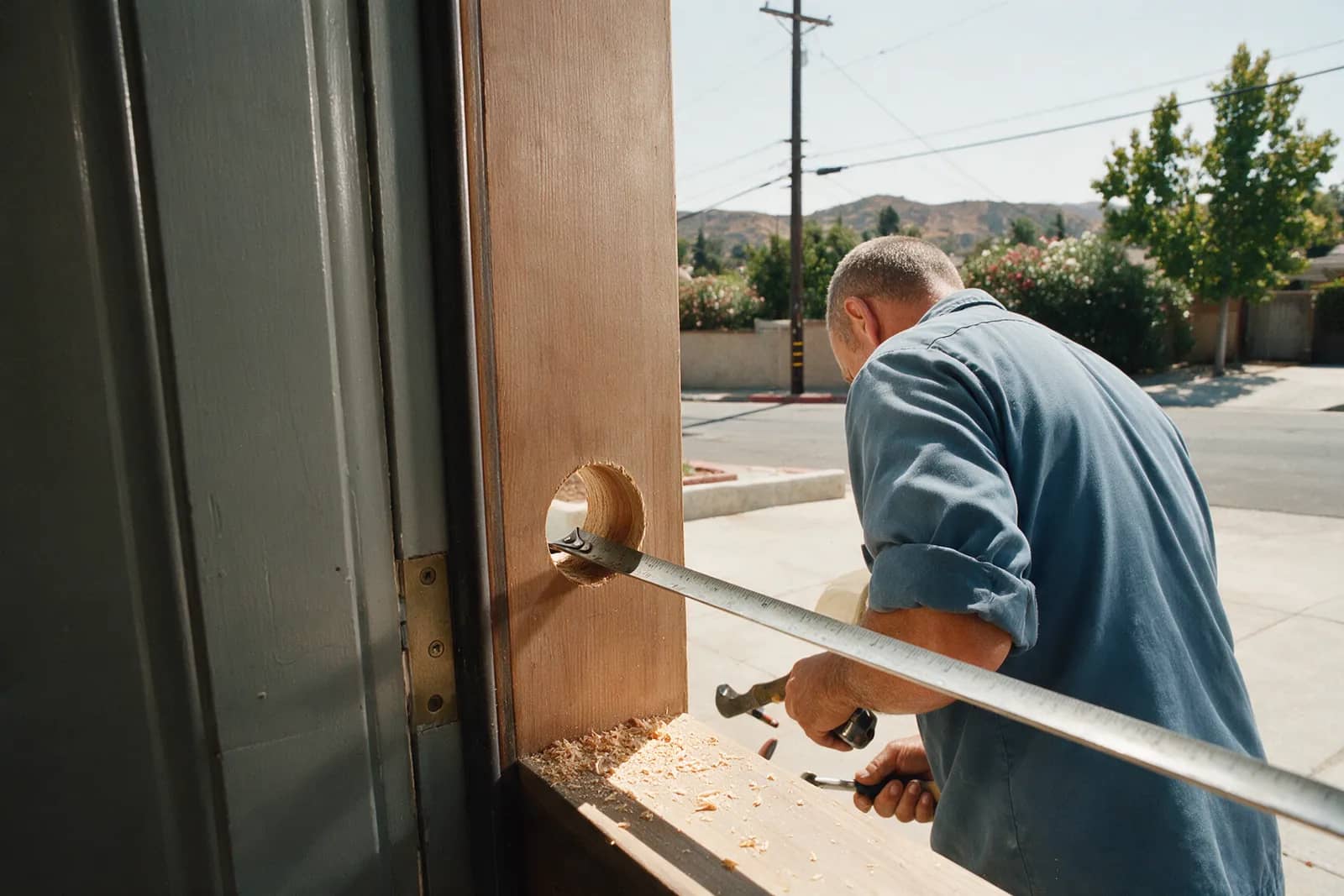
Four numbers describe a bored door, and between them they settle the whole conversation. The face bore is the round hole through the face of the door, and on anything built here after the mid fifties it is almost always 2-1/8 inches. The edge bore is the smaller hole drilled into the edge of the door to meet it, normally 1 inch. The backset is the distance from the edge of the door to the center of the face bore, and it is either 2-3/8 or 2-3/4 inches. Those two backsets are the whole story of most retrofits that go wrong.
The fourth is thickness. A 1-3/4 inch exterior slab takes almost anything on the market. A 1-3/8 inch slab, which turns up on plenty of side doors, garage doors into the kitchen and a fair number of original front doors on the older tract streets, is thinner than a lot of modern hardware expects, and the tailpiece, the screw posts and the chassis depth all have to suit it. None of this needs a technician to measure it for you before a decision is made. Say the street, say whether the door is an original slab or a replacement, and the numbers are usually known already.
What drops straight in
A great deal does. A knob for a knob, a lever for a knob, a modern deadbolt for a 1970s deadbolt, a keyed entry set for a plain passage set, all of it goes into a 2-1/8 inch bore with a 1 inch edge bore as long as the backset matches and the latch face is the same shape. Latch faces come radius-cornered or square, and swapping one for the other means a chisel cut in the edge of the door, which is small work but is not nothing on a door with fifty years of paint on it.
Most current hardware ships with an adjustable latch that covers both backsets, which is why a homeowner buying a box at a store on Willow Pass Road usually finds it fits. What that box does not solve is the ring. Sixties knob roses were often wider than what is sold now, and when a small modern rose goes on, it leaves a halo of unpainted or differently faded wood around it. On a painted door that is a touch-up. On a stained door it is visible forever, and it is worth knowing before the old set comes off rather than after.
What does not fit without cutting wood
Three things regularly do not. A mortise lock needs a rectangular pocket chiseled into the edge of the stile, and a bored door has a round hole where that pocket would go, so fitting one means routing out the edge and filling the face bore. That is joinery, not lock work, and on a hollow-core or a thin slab it is often not worth doing at all. An interconnected set, where the knob and the deadbolt work off one lever, needs two bores at a fixed spacing that rarely matches whatever spacing your door already has. And any wide escutcheon plate covers holes rather than fixing them, which is fine as an outcome and poor as a plan.
The other regular refusal is a lock with a deep interior chassis on a 1-3/8 inch door. The screw posts bottom out, the thumbturn stands proud, the door will not close on its own stop. There is usually a version of the same lock made for the thinner slab, and asking for it by thickness rather than by model is what avoids two trips. If the honest answer is that a particular lock will not sit on a particular door, that is said on the call, not discovered halfway through with the old lock already in a bag.
Smart locks on a door built in 1961
Smart locks are the commonest upgrade asked for on these streets now, and they mostly do fit, because nearly all of them are built to drop into the same 2-1/8 inch bore with an adjustable backset. Smart lock installation is $175 to $435, and where a job sits in that band is about the door and the network, not the badge on the box. What actually decides it: whether the slab is thick enough for the interior chassis, whether the strike and the frame let the bolt throw fully, and whether there is signal where the door is.
That last one bites on this housing stock. A garage side door or a back door on a detached garage at the end of a long driveway can sit far enough from the router that the lock reports fine on the day and drops off in a month. The other thing worth naming is the bolt. A smart deadbolt drives its bolt with a small motor, and a motor has less patience than a wrist. A door that needs a shoulder before the old bolt goes home will jam a smart lock within weeks. On these doors the frame and the strike get sorted first, and then the lock goes on a door that closes properly.
Saying the street on the call, and the figures
This is the reason a figure can be said on the call rather than guessed at the door. Name the street and roughly the year of the house, say whether the door is original or a replacement and whether there is one hole or two in it, and the bore, the backset and the strike are known while you are still on the call. Lock replacement and installation is $112 to $285 per door. A smart lock is $175 to $435. Rekeying an existing cylinder, which is what most people actually want when they say they need new locks, is $25 to $40 a cylinder, and the cylinders get counted on the call so one figure covers the house. Arrival across Concord runs sixteen to twenty-six minutes.
Todos Santos Lock Co. works to The Known Door. The figure is said on the call and it holds the visit, the labor and the parts inside it. That same figure is what appears on the receipt, whatever the technician finds once the trim is off. The lock is opened without damage first, and a drill only comes out after you have agreed to it, and it never buys a higher figure. Card or tap at the door, an itemized receipt by email, and a written line for a landlord, a manager or an insurer when one is wanted. Calls are answered 24/7, with $40 sitting inside the figure between 8pm and midnight and $75 between midnight and 7am, which puts a late call higher inside its range rather than past the top of it.
Quick answers
How do I know what backset my door has?+
Measure from the edge of the door to the center of the round hole. It will be either 2-3/8 or 2-3/4 inches, and on Concord tract streets the whole street usually shares one. Most current hardware ships with a latch that adjusts to both, so the backset rarely stops a swap on its own.
Can I put a smart lock on a 1961 front door?+
Usually yes, since nearly all of them are made for the same 2-1/8 inch bore. The three things that decide it are slab thickness, whether the bolt throws fully into the strike, and whether there is signal at that door. Installation is $175 to $435 with the $89 visit already inside the figure.
Why does my new knob leave a bare ring on the door?+
Sixties roses were wider than most of what is sold now, so a smaller modern rose exposes wood that has not seen sun or paint since the house was built. On a painted door it is a touch-up. On a stained door it does not blend, so it is worth choosing a set with a wide rose from the start.
Need it handled rather than read about?
(925) 421-2295More guides