The door at the back of every tract house
Walk any street of sixties houses in Sun Terrace, Meadow Homes or along the Ygnacio Valley spine and the back of each house is the same: a pair of full-height aluminum panels in an aluminum track, one fixed, one sliding, opening onto a concrete patio. It was cheap, it was light, it let the light in, and it went into tens of thousands of houses across the county in about a decade.
Sixty years later it is the door people describe as never having locked properly. That description is usually accurate and usually blamed on the wrong part. The little latch in the stile is what people can see, so the latch is what gets called about. In most of these houses the latch is a symptom, and swapping it without looking at the rest of the door buys about eight months.
What the factory latch actually is
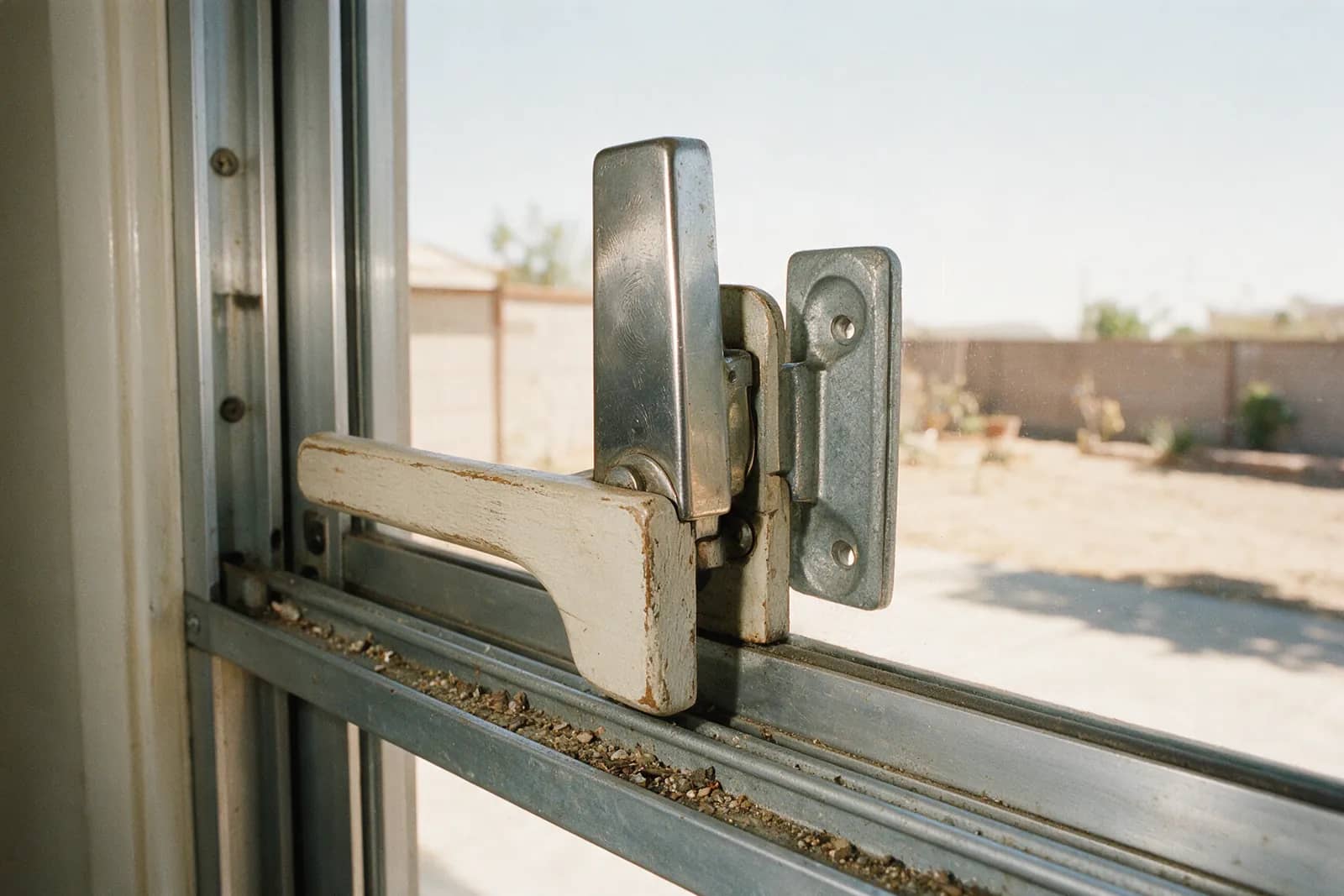
Lift the handle on an original slider and a small hook or a clamping tongue swings out of the edge of the moving panel and catches a keeper screwed to the jamb of the fixed side. The mechanism is a stamping and a casting of pot metal, riveted rather than screwed into a hollow aluminum stile, with a light spring behind it. It was designed to hold a panel shut against a breeze and a curious dog. It was not designed to resist anything, and it was never meant to be serviceable.
Three things kill it. The rivets work loose after decades of the handle being yanked, so the whole assembly floats in the stile and the hook stops presenting squarely to the keeper. The pot metal cracks, most often across the hook itself, and then the handle lifts freely and nothing comes out. Or the spring tires so the hook drops out under its own weight and rides against the frame every time the door moves. All three produce the same complaint: it has to be lifted, leaned on and jiggled before it catches.
The three faults that are not the latch
First, the rollers. Every sliding panel rides on two small wheels at the bottom, adjustable through a screw hole at each end of the bottom rail. Sixty years of grit turns those wheels flat or seizes them, and the panel sinks a few millimeters. Now the hook meets the keeper below where it should, and no latch on earth will fix that. Winding the rollers up, or replacing them, brings the panel back to height and very often the original latch starts catching again.
Second, the track. The bottom track fills with soil, leaf litter and the grit that comes off the patio, and a panel dragging through that gets shoved rather than slid, which is what loosens the rivets in the first place. A vacuum and a stiff brush is a genuine repair here. Third, lift. An old panel with worn rollers can often be lifted up into the head track far enough to swing out of the bottom track entirely, which means the latch is irrelevant to whether that door can be opened. That one is worth checking on your own door this afternoon.
What actually replaces it
For the latch itself, there are modern replacement assemblies that fit the common sixties stile profiles, usually screwed rather than riveted, with an adjustable keeper so the engagement can be set to where the panel now sits. Where a matching part exists it is the tidy answer. Where the stile is an oddity, and some of the early aluminum frames are, the honest answer is that no drop-in part exists and the door gets secured a different way.
The different way is usually three inexpensive things working together. A foot bolt or a pin bolt through the moving panel into the track, which holds the panel even if the latch has given up entirely. Anti-lift screws driven into the head track above the panel, set so the door still runs but cannot be lifted clear. And a bar in the track for nights, which is crude but is the only part of the arrangement that does not care about the condition of the panel. A keyed patio lock is available too, and it is worth one caution: this is the door people use to get out to the yard, so a lock that needs a key from the inside on a door people pass through daily is a bad trade. Slider hardware sits in lock replacement and installation at $112 to $285 depending on the panel and the part.
What should not be screwed near that glass
Two cautions on these particular doors. Glass in a slider from before the late seventies may not be tempered. It can be ordinary annealed plate, which breaks differently and less kindly than modern safety glass. Nothing gets levered against it and nothing gets drilled through the glazing bead where a bit can wander. Any fastener into the frame goes into aluminum with clearance from the glass edge, or it does not go in.
The other is drilling the track. There is a persistent idea that a screw driven down through the bottom track stops a slider being forced. It also puts a hole through the section that carries the water out of the door, and on a tract house the sill of that track is often the top of the slab. Water finds it. If a mechanical stop is wanted at the bottom, it is a bolt through the panel into a fitted keeper, not a fastener straight through the drainage. Sliders get a hard time from the sun on this side of the hill and there is no need to add a leak to that.
Locked out through the slider, and the figures
A slider produces its own kind of lockout: somebody steps out to the patio, the panel bumps closed behind them, and the latch drops. That is a house lockout at $115 to $195, opened without harm to the door, with the $89 visit already counted inside the figure. Evenings are when this call comes, so the $40 that applies between 8pm and midnight is already inside what is said rather than added at the door, and the same holds for the $75 between midnight and 7am. Latch and hardware work is $112 to $285 per door. Arrival across Concord is sixteen to twenty-six minutes, nineteen to the Sun Terrace streets and twenty-three along Ygnacio Valley.
The Known Door applies here as everywhere. One figure is said on the call and it holds the visit, the labor and the parts. The receipt shows that same figure whatever the panel turns out to be doing. The door is opened without damage first, and if anything more invasive is ever the only route left it waits on your word and does not raise the number. Card or tap at the house, an itemized receipt by email, and a written line for a landlord, a manager or an insurer when one is needed. Calls are answered 24/7.
Quick answers
My patio slider will not latch unless I lift it. Is that a new latch?+
Usually not on its own. The rollers under the panel have worn or seized and the panel has sunk, so the hook meets the keeper below where it should. Winding the rollers back up, clearing the track and adjusting the keeper often brings the original latch back into service.
Can a sixties aluminum slider be given a proper lock?+
Yes, either with a replacement latch assembly that suits the stile, or with a foot bolt through the panel, anti-lift screws in the head track and a bar for nights. Slider hardware runs $112 to $285 per door with the $89 visit inside. A keyed lock needing a key from the inside is a poor idea on a door people use to reach the yard.
I am shut out on the patio. What does that cost?+
It is a house lockout at $115 to $195, with the $89 visit already inside the figure and the door opened without harm to the panel or the glass. Evening and overnight amounts of $40 and $75 also sit inside the figure, so a late call lands higher in that range rather than above it.
Need it handled rather than read about?
(925) 421-2295More guides